Why Enterprise Multi-Carrier Bonding Outperforms Traditional Cellular Failover

For distributed enterprises, remote job sites, and mission-critical branch operations, network resilience is no longer an operational luxury—it is fundamental to revenue protection. According to recent Gartner benchmarks, the enterprise cost of network downtime regularly exceeds $5,600 per minute, rising exponentially when payment systems, real-time telemetry, or collaborative cloud tools drop offline.
Historically, network engineers addressed WAN vulnerabilities by adding a single cellular modem configured for passive failover. When the primary fiber or broadband line drops, the edge gateway switches to cellular. However, modern operational environments—such as dynamic commercial construction trailers, distributed retail hubs, and high-density edge IoT nodes—expose critical architectural flaws in legacy failover models.
Understanding the transition from active-passive failover to active-active multi-carrier aggregation is vital for engineering resilient wide area networks.
The Technical Limits of Traditional Active-Passive Failover
Traditional failover architectures deploy a secondary WAN link that remains idle until the primary link fails health checks. While technically functional on paper, real-world deployment reveals severe friction points:
- BGP and DNS Convergence Latency: Standard failover is rarely instantaneous. Health probes (such as periodic ICMP pings or TCP handshake tests) must register multiple failures before triggering cutover. This creates an unrecoverable connectivity gap lasting anywhere from 10 to 45 seconds.
- Session Drops and State Table Reset: Existing stateful sessions—including active SSH channels, VoIP calls, VPN tunnels, and Point of Sale (POS) card authorizations—collapse during link renegotiation, forcing users to re-authenticate.
- Single-Point Radio Failures: A cellular backup line tied to a single national carrier remains susceptible to tower congestion, localized carrier maintenance, or physical spectrum degradation.
The Architecture of Carrier Aggregation and WAN Bonding
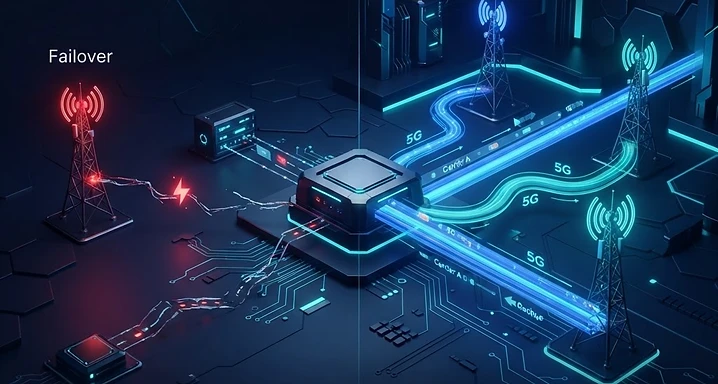
To overcome the limits of legacy failover, enterprise infrastructure is increasingly shifting to packet-level multi-carrier bonding. Rather than keeping redundant links in cold standby, active bonding combines multiple simultaneous cellular links—spanning distinct Tier-1 carrier backbones—into a unified, logical data pipe.
At GuardianLink Networks, our engineering methodology relies on three foundational pillars to guarantee continuous uptime:
- Dynamic Virtual SIM (VSIM) Provisioning: Rather than depending on static, physical SIM cards locked to one provider, software-defined VSIM profiles dynamically connect to the strongest local cell tower across competing networks, avoiding single-carrier coverage gaps.
- Packet-Level Distribution with Forward Error Correction (FEC): WAN traffic is broken down at the packet level across bonded channels. If carrier A encounters jitter or a transient micro-outage, carrier B and carrier C instantly absorb packet delivery without breaking the overlying TCP tunnel.
- Sub-Second Failover Without Session Reset: Because multiple paths are continuously active, zero-loss handover occurs in real time. Latency spikes are smoothed out dynamically, preserving VoIP calls and encrypted data streams.
To see how dynamic aggregation integrates with your existing edge routers, check our breakdown on how our multi-carrier architecture works.
Edge Deployments: Meeting Rigorous Compliance and Security
Transitioning mission-critical applications to cellular environments requires robust security at the physical and network boundaries. Broadening the edge perimeter necessitates compliance standards that match conventional data center topologies.
- Automated SOC 2 Compliance: Hardware endpoints must maintain encrypted configuration channels, robust auditing logs, and zero-touch remote provisioning to prevent lateral network movement.
- End-to-End Encryption: Traffic traversing public cellular spectrum should default to IPsec or WireGuard tunneling, wrapping bonded data streams in 256-bit AES encryption before traversing public infrastructure.
- Physical Resilience: Edge routers deployed in industrial settings or job trailers require wide-temperature components, external high-gain antenna arrays, and intelligent multi-WAN health-check daemons.
Explore our enterprise-grade hardware and customized data configurations on our connectivity solutions page.
Future-Proofing Your Wide Area Network
Passive cellular backup is no longer sufficient for organizations that depend on uncompromised data integrity. As enterprise applications become increasingly real-time and distributed, passive failover architectures introduce unnecessary downtime risks that disrupt productivity and breach SLAs. Multi-carrier bonding bridges this gap by transforming diverse cellular links into an unbreakable, high-throughput WAN connection.
Ready to eliminate downtime and engineer carrier redundancy into your infrastructure? Request a custom connectivity quote from the GuardianLink Networks technical team today.
Editorial Disclosure: Articles on GuardianLink Networks are produced by our editorial team. Author names and images are illustrative personas representing our collective industry expertise.
Get connectivity insights
Join our newsletter for the latest on 5G failover, VSIM technology, and enterprise connectivity.
By subscribing, you agree to receive marketing emails from GuardianLink Networks. You can unsubscribe at any time.
Ready to upgrade your connectivity?
Tell us about your deployment — we'll match hardware and data plans to your needs.
Request a Quote